

Europe in a dead end”: Gerhard Schröder’s shocking reckoning with Ursula von der..konkon
“Europe at a Dead End”: Gerhard Schröder’s Shocking Takedown of Ursula von der Leyen
the world of politics, there are moments when a single interview can shake the very foundations of power. One such moment unfolded recently when former German Chancellor Gerhard Schröder spoke out. In a conversation now sparking intense debate in Brussels and Berlin, he delivered unusually blunt and scathing criticism of European Commission President Ursula von der Leyen. His core message: under her leadership, Europe is being driven into a dangerous dead end—one that is hitting Germany especially hard.
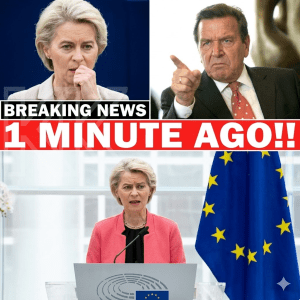
Schröder, a seasoned power broker who knows the political stage like few others, holds nothing back. This is not about minor policy disagreements—it is, in his view, a fundamental failure across the core pillars of European governance. Energy, security, economic stability—his verdict is devastating.
The Energy Crisis as Political Failure
One of Schröder’s harshest criticisms targets energy policy. Under von der Leyen’s leadership, Germany has endured its most severe energy price crisis in decades. Gas prices at times surged up to tenfold, pushing households to the brink and striking at the heart of Germany’s industrial backbone. Countless companies were forced into insolvency, while competitors in the U.S. and China benefited from significantly lower energy costs.
According to Schröder, this was no unavoidable misfortune—it was the result of an “energy transition without a Plan B.” He argues that Europe first drifted into dependency, only to abruptly reverse course in a way that put the continent’s economic stability at risk. The burden of this experiment, he says, is being carried by citizens and businesses, while a clear strategy for affordable energy remains absent.
A Breakdown in Security and Foreign Policy
Schröder also sees serious failures in geopolitics. As global powers like Russia and China expand their military capabilities and the world grows increasingly unstable, he believes the EU under von der Leyen has failed to position itself as a strong, independent actor. Instead of prioritizing diplomacy and strategic dialogue, he accuses the leadership of rigid ideological thinkin

